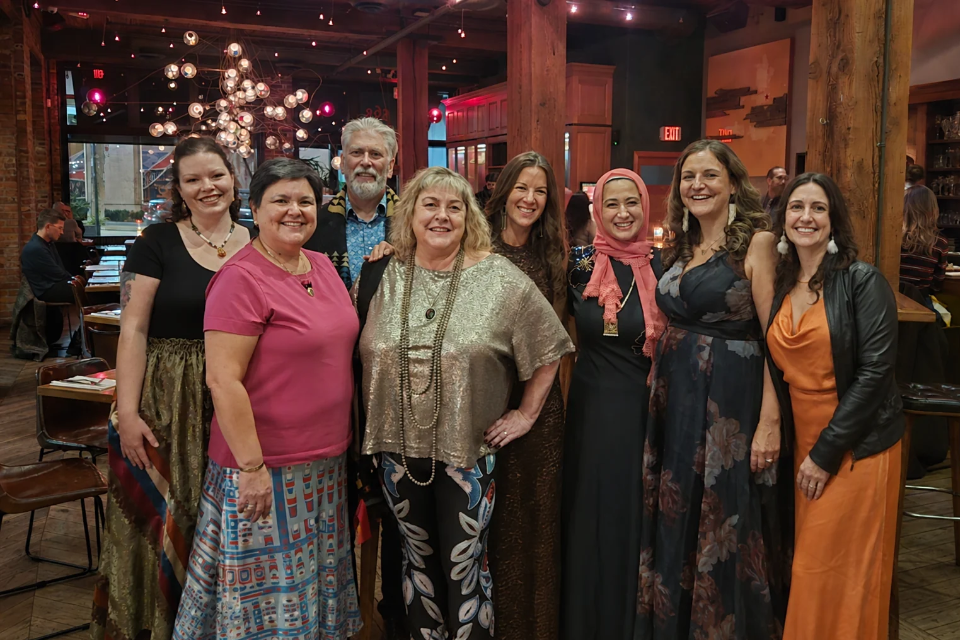
Story shared by Annie Korver
At Rise, our work in Truth, Reconciliation, and Indigenous inclusion is transformative for both those we are invited to walk alongside and for us. From intention to impact is more than a statement on our website; it is a philosophy that guides how we work, how we engage, and how we intentionally create experiences that inspire meaningful and lasting change. The most impactful experiences rarely happen by accident. They are thoughtfully designed with purpose, care, and attention to the people who will experience them. Our Gratitude Gathering was one example of that teaching in action.
Last week, our team gathered on the unceded traditional territories of three Coast Salish First Nations: the xʷməθkʷəy̓əm (Musqueam), Sḵwx̱wú7mesh Úxwumixw (Squamish), and səlilwətaɬ (Tsleil-Waututh) Nations, in Vancouver, for two days of reflection, learning, planning, celebration, and most importantly – gratitude. We refer to it at Rise as our annual Gratitude Gathering, and while the gathering marked the end of another impactful year, it was a living example of the values and approaches that shape our work every day at Rise.
We began our time together on Thursday with a feast and an impact exercise facilitated by our friend Kim van der Woerd (Namgis First Nation). Together, we reflected on our work at Rise and the change we seek to create as we advance our purpose. It was an opportunity to pause and consider not just what we do, but the impact our work has on the people, communities, and organizations we serve. Building on willow teachings shared earlier this year by Shaun Vincent (Métis Nation), Kim led us as we reflected on stories of change, and we imagined a willow basket holding what we have gathered. She asked us to also consider what is difficult to hold, what we leave with others and what we have yet to gather.
After lunch, Sxwpilemaát Siyám Chief Leanne Joe (Squamish Nation) guided us one-by-one through a cedar brushing ceremony. As cedar swept away what no longer served us, we were invited to set intentions for the conversations and work ahead. The remainder of Thursday focused on reflection and renewal. We looked back on the year together, celebrating accomplishments, sharing what worked well, and acknowledging moments that reflected our values and the seven Rs in action. We also created space for dialogue about challenges, lessons learned and growth opportunities. Before the day concluded, we turned our attention to 2027, sharing aspirations for what we hope to experience, create and achieve together in the year ahead.
The intention carried forward into Friday morning when we were up before dawn to go to Lynn Creek, where we were guided by Sxwpilemaát Siyám Chief Leanne Joe (Squamish Nation) and Elizabeth Ross (Squamish Nation) through a spirit bath ceremony. Together, we set intentions and reflected on what we were ready to release. Four dunks (in very chilly water) later, the flowing water was both a teacher and witness, helping us let go of what we no longer carry, creating space for what comes next. The experience was deeply personal, powerful and emotional for each of us. Following the ceremony, we gathered for breakfast at the White Spot in honour of the late Martha Matthew (Simpcw First Nation), whose influence and spirit continue to be felt at Rise, and then we spent time learning together at the Museum of North Vancouver, deepening our understanding of the stories that shape the territory.
Later in the day, our friend Justin Deonarine of Culture Shift Consulting facilitated an activity that helped us further get to know each other. Through reflection and discussion, we explored how we interact with others, contribute to our team, approach tasks, and navigate relationships with a focus on communication and conflict. The activity strengthened something essential for us: understanding and connection to each other. As we prepared for the evening, Kate-Lynn Stonechild (Muscowpetung First Nation) of Stonechild Beauty did our makeup and dinner at Chambar was followed by Indigenous Futurism Night at Vancouver Indigenous Fashion Week. It was an extraordinary experience. Stella Standingbear (Oglala Lakota Nation) and Keifer Collison (Haida Nation) were fantastic emcees; we were energized by DJ Kookum and as the night rolled on, we witnessed powerful expressions of Indigenous creativity, identity and innovation. Designers including The Historymkrs, Maison Delirium, Alicia’s Designs, Jason Baerg, Girls Who Leap, Notorious Cree, and Janeen Frei Njootli each shared collections that were unique, yet connected through a common thread of story, resilience and futurism.
As I reflect on the experience, I return to a conversation I had earlier this year with my friend and colleague Patti Derbyshire about the relationship between design and impact. Patti introduced me to the work of renowned designer Dieter Rams and his principles of good design. Principle #8 resonates right now: Good design is thorough down to the last detail. Rams believed that nothing should be arbitrary or left to chance. Care and accuracy in the design process demonstrate respect for the people who will experience it.
The most impactful experiences rarely happen by accident; they are intentionally and purposefully designed. While some might describe our time together as a strategic planning retreat or a team retreat, those naming conventions do not accurately capture what it was. Perhaps there is an invitation in my story to consider not only what happens when your team gathers, but why and how. When we approach team time with intention, ceremony, reflection, and connection, the outcomes can extend far beyond strategic planning. They can strengthen culture and relationships, deepen belonging and reinforce a shared sense of purpose.